
Check the claims before you choose a crypto casino
A practical look at Bitcoin transactions, privacy limits, offshore access, and the evidence behind casino and bonus claims.

Table of Contents
Table of Contents
- Bitcoin Deposits, Withdrawals, and Transaction Trade-offs
- What “Anonymous” Means—and What It Does Not
- Offshore Platforms, Online Pokies, and Access in Australia
- No-Deposit Bonuses and the Limits of What Can Be Verified
- Assessing Casino Claims Without a Verified Ranking
- Casino Sites, Domain Blocking, and Consumer Protection
- Cryptocurrency Choices and Their Tax Treatment
- Casino Apps, Crypto Volatility, and Verification
- How to Read Casino Lists and Date-Specific Claims
- New Casino Claims and the Evidence Gap
Bitcoin Deposits, Withdrawals, and Transaction Trade-offs
Bitcoin is one of the most widely supported cryptocurrencies at offshore crypto casinos, alongside Ethereum. Its role in a deposit or withdrawal depends on the platform’s payment instructions and on the Bitcoin network itself. A transfer is not simply a card-style payment: it is a blockchain transaction sent from one address to another, and the address and network details have to match the instructions shown for that transaction.
For a deposit, the casino supplies a receiving address and may also display a QR code. The sending wallet is used to make the transfer. Before confirming it, the address should be checked in full and the selected asset should be Bitcoin on the Bitcoin network. A copied address can be compared with the one displayed by the platform; relying only on a familiar-looking beginning or ending is not enough to establish a match. If a payment page specifies a particular network or asset, a transfer using different details may not arrive as intended and may be difficult or impossible to recover.
Top operators
For an anonymous crypto casino in Australia, checking what is actually stated about each operator can help you assess the available options without assuming that every site offers the same terms. Use this list as a starting point and verify any details relevant to your own choice.
-
House of Pokies
- License
- international iGaming licence – jurisdiction not named in the source
- Payout speed
- PayID 1-24 hours
- Min. deposit
- A$30 (PayID from A$10)
House of Pokies states that its international iGaming licence has no named jurisdiction in the available information. Its stated PayID payout speed is 1–24 hours, and the minimum deposit is A$30, or A$10 when using PayID.
-
Playfina Casino
- License
- Curacao eGaming (Hollycorn N.V., since 2017)
- Min. deposit
- A$20-30 (depends on the offer)
Playfina Casino is listed with a Curacao eGaming licence held by Hollycorn N.V. since 2017. Its minimum deposit is A$20–30, depending on the offer.
-
DragonSlots Casino
- License
- Curacao Gaming Authority (Jumpman Gaming Ltd)
DragonSlots Casino is listed with a Curacao Gaming Authority licence associated with Jumpman Gaming Ltd.
-
WinSpirit Casino
- License
- Curacao eGaming OGL/2024/923/0383 (Antillephone N.V.)
- Min. deposit
- A$30
WinSpirit Casino is listed with Curacao eGaming licence OGL/2024/923/0383, held by Antillephone N.V. Its stated minimum deposit is A$30.
-
Roby Casino
- License
- Curacao eGaming (Roby Games Ltd)
Roby Casino is listed with a Curacao eGaming licence held by Roby Games Ltd.
-
LevelUp Casino
- License
- Curacao eGaming OGL/2023/174/0082 (Dama N.V.)
- Min. deposit
- A$15
LevelUp Casino is listed with Curacao eGaming licence OGL/2023/174/0082, held by Dama N.V. Its stated minimum deposit is A$15.
-
LuckyVibe
- License
- Curacao Gaming Control Board OGL/2023/176/0095 (Hollycorn N.V.)
LuckyVibe is listed with a Curacao Gaming Control Board licence, OGL/2023/176/0095, held by Hollycorn N.V.
-
Lucky Dreams
- License
- Curacao
- Min. deposit
- A$20 (POLi)
Lucky Dreams is listed as licensed in Curacao. Its stated minimum deposit is A$20 when using POLi.
-
Thor Casino
- License
- Curacao – Antillephone N.V. (Versus Odds B.V.)
- Min. deposit
- EUR 20
Thor Casino is listed with a Curacao licence associated with Antillephone N.V. and Versus Odds B.V. Its stated minimum deposit is EUR 20.
-
Bizzo Casino
- License
- Curacao Gaming Control Board (TechSolutions Group N.V.)
Bizzo Casino is listed with a Curacao Gaming Control Board licence held by TechSolutions Group N.V.
The same care applies to withdrawals. A Bitcoin withdrawal requires a destination address that can receive BTC on the relevant network. The address should be copied from the receiving wallet and checked before the request is submitted. A casino balance and a wallet balance are separate: a withdrawal request must first be processed by the platform, after which the transaction can be broadcast to the network. These are distinct stages, so a platform’s processing status should not be confused with confirmation in the blockchain.
Bitcoin’s trade-off is not simply that it is “slow” or “fast.” Network conditions affect how quickly a transaction is confirmed, and a fee affects the incentive for miners to include it. Neither the casino’s internal processing time nor the network confirmation time can be inferred from the currency name alone. The amount of time a transfer takes may therefore differ between transactions. A specialist review describes Bitcoin as suitable for larger, less frequent cashouts when a wait of around half an hour is not a concern. That is a context-specific assessment, not a guaranteed payout time or a universal rule for every casino or transaction.
This makes Bitcoin a different choice from currencies selected primarily for quicker, lower-cost transfers. A specialist review recommends Litecoin and Tether sent over the TRC-20 network for faster payouts, citing confirmation speed, low fees and broad support. That recommendation should not be treated as a standing promise about every platform: payment options, network support and processing arrangements can change. In particular, the word “Tether” alone is not enough to identify the transfer route. Tether exists on multiple networks, and the sending and receiving sides must specify the same one.
The relevant comparison is therefore between the full payment route, not just the ticker symbol. Bitcoin uses its own network; a token such as Tether may require a separate network selection. Fees and confirmation behaviour differ by network, while a casino may add its own review or processing stage before a withdrawal is released. A lower network fee does not establish that the overall withdrawal will be quicker, and a fast blockchain confirmation does not establish that a casino will process a request promptly.
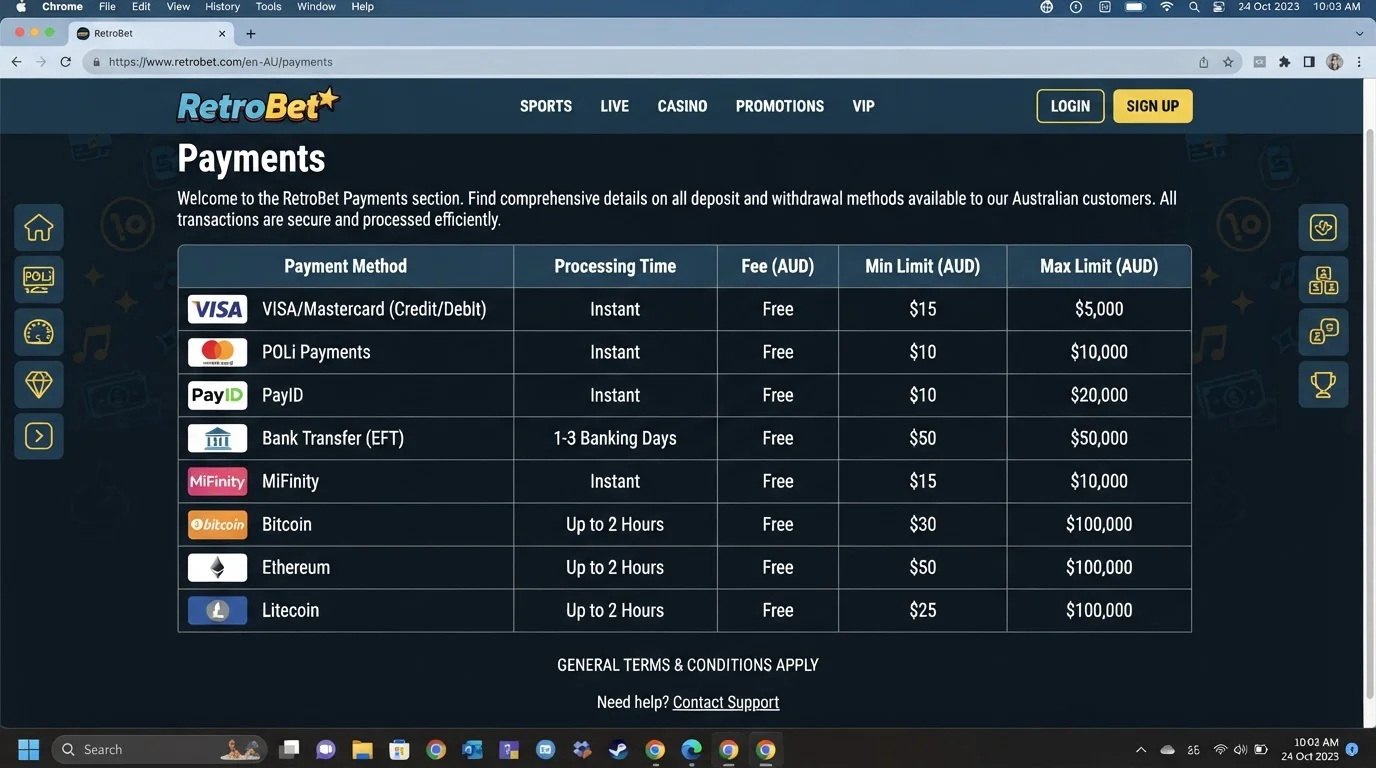
A transaction can also be difficult to reverse. Cryptocurrency transfers do not work like a payment that can simply be cancelled through a card provider after the address has been entered. This is why checking the asset, network and destination before sending matters more than relying on a payment label or saved address. A small test transfer may not solve every risk: the platform’s minimums and procedures vary, and a separate transfer can involve additional fees. Those terms need to be read as platform-specific rather than assumed to be standard.
Bitcoin deposits also have a tax dimension beyond the payment mechanics. The ATO treats cryptocurrency as a capital gains tax asset, and disposing of crypto can be a CGT event. Sending Bitcoin to a casino as a deposit may itself count as a disposal, independently of any later gambling result. This means the deposit transaction and a subsequent win or loss are separate events for tax analysis; the fact that the transfer is made to fund play does not erase its status as a disposal.
Do
- Check the destination address in full
- Match the asset and network to the platform's instructions
- Maintain separate records of wallet and casino histories
Don't
- Rely only on the beginning or ending of an address
- Use a different network than the one specified
- Confuse platform processing status with blockchain confirmation
A transaction record can help distinguish these events. Wallet histories and transaction identifiers show the movement of Bitcoin on the network, while a casino account history records the platform-side credit or withdrawal request. Keeping both records makes it easier to reconcile what was sent, what was credited and what was later withdrawn. The records do not change the network outcome, but they preserve a clearer account of the transaction path.
Bitcoin can be a practical option where its support and network are useful and the timing trade-off is acceptable. The important distinction is between the casino’s handling of a request and the blockchain’s confirmation of a transfer. Matching network details and maintaining a record of each movement are central to handling either a deposit or a withdrawal accurately.
What “Anonymous” Means—and What It Does Not
“Anonymous” can describe different things: whether a payment is made in cryptocurrency, whether an account is linked to a person’s identity, or whether activity is hidden from outside parties. These are not equivalent. A crypto payment does not, by itself, establish that an account can be opened or used without identity checks. Nor does a label such as “no-KYC” prove that checks will never be requested.
A platform may set its own account and verification requirements, and those requirements can matter at different stages of using a service. The fact that a deposit is made in cryptocurrency says nothing conclusive about what information the operator may request. Claims that a crypto casino is anonymous should therefore be read as claims about a particular service, not as a property guaranteed by the currency.

Cryptocurrency should not be treated as a shield against identification or as evidence that a platform is safe. Even where a service describes itself as anonymous, that description does not establish how it handles identity information, whether it will ask for documents, or what recourse exists if an account or transaction is disputed. The available distinction is narrower: using crypto does not, on its own, remove the possibility of identity verification.
The Australian legal setting
The Interactive Gambling Act 2001 prohibits operators from providing online casino games to people in Australia. The restriction applies to services offered to people physically in the country; it is not a local licensing framework under which offshore crypto casinos become approved. Such offshore platforms are not licensed in Australia and sit outside the Australian regulatory framework.
The Australian Communications and Media Authority (ACMA) is responsible for online gambling regulation under the Act. The legal target is the operator providing a prohibited service, rather than the individual using it. Accessing an offshore casino is not a criminal offence for an Australian player. That distinction does not make the service lawful for its operator to provide, nor does it amount to regulatory endorsement of the platform.
An offshore operator’s statements about privacy, verification or account access do not replace Australian oversight. Because these services are outside the country’s regulatory framework, they do not carry Australian consumer protection. If a dispute arises, the protections and complaint routes available for locally regulated services cannot simply be assumed to apply. A privacy claim and a consumer safeguard are separate matters.
The phrase “anonymous crypto casino Australia” can consequently suggest more certainty than the underlying conditions justify. It may point to a platform’s marketing or payment method, but it cannot establish that the operator has no identity checks, that a user cannot be identified, or that the service is protected under Australian law. The legal position concerns the operator’s provision of the service; the privacy position depends on what the platform actually requires and how it operates.
Age is a separate condition from privacy and payment method: gambling is for people aged 18 or older. Meeting that age requirement does not change the status of an offshore platform or provide Australian consumer protection.
Anonymity is therefore best understood as a limited claim, not a guarantee. Cryptocurrency use alone does not settle whether identity checks apply, and an offshore service’s description of itself does not establish local approval or recourse. Those limits remain relevant even when a platform presents crypto use as a way to play privately.
Offshore Platforms, Online Pokies, and Access in Australia
Online pokies and other casino-style games may be offered through offshore websites, but their availability on the internet does not make them lawful services for the Australian market. The Interactive Gambling Act 2001 prohibits operators from providing real-money online casino games to people in Australia. This includes services such as pokies, poker and table games. The restriction concerns the operator’s provision of the service; it does not mean that an Australian-licensed casino can lawfully offer these games to local residents.

Offshore websites operate outside Australia’s regulatory framework. Their presence online, or their willingness to accept cryptocurrency, does not give them Australian authorisation. Nor does it establish that access will remain available. The legal position of the service and the practical ability to reach its website are separate matters: a site may be visible at one point and unavailable later.
The Australian Communications and Media Authority (ACMA) regulates online gambling under the Act. It monitors online gambling activity, including activity involving cryptocurrency, and directs internet service providers to block prohibited offshore gambling sites. A specialist gambling review reported that blocking notices had covered hundreds of domains by mid-2025. That is a dated report, not a count that should be treated as fixed: domains and blocking actions can change over time.
Blocking can interrupt access to a particular web address, but it does not necessarily establish that the underlying operator has ceased operating. A service may use another address, while an existing domain may stop loading for Australian users. Consequently, the appearance of an accessible site is not reliable evidence that it is permitted to serve the Australian market or that access will continue. ACMA’s enforcement activity makes availability an uncertain feature of offshore casino websites, rather than a dependable measure of their legal status.
For Australian users, the law does not make it a criminal offence to gamble at an offshore online casino. That distinction should not be confused with approval or protection: the operator remains outside the Australian regulatory framework, and there is no Australian consumer protection for the service. The prohibition is directed at operators offering the service, not at individual players. All gambling is restricted to people aged 18 or older.
The phrase “anonymous casino” does not alter these distinctions. Cryptocurrency may be a payment option, but it does not change the prohibition on operators offering real-money casino games to people in Australia, nor does it prevent ACMA from monitoring online gambling activity. A website’s claims about privacy or access cannot override the law or guarantee that its domain will remain reachable.
Accordingly, offshore availability and lawful local provision are not interchangeable. Online casino games may be encountered on offshore platforms, while their provision to Australian residents remains prohibited under the Interactive Gambling Act. ACMA-directed blocking adds a practical complication: even a functioning domain may become inaccessible, and an accessible domain does not demonstrate that the service is authorised in Australia.
No-Deposit Bonuses and the Limits of What Can Be Verified
A no-deposit bonus is presented as a promotional credit available without first funding an account. In crypto-casino advertising, such claims may be paired with words such as “anonymous” or “instant withdrawal”. Those labels do not establish that an offer exists, that it is available to Australians, or that any resulting balance can be withdrawn. Without an identifiable, current promotion and its complete terms, the claim cannot be treated as a usable offer.
The distinction between a displayed bonus and money that can be withdrawn matters. A promotion may describe a credit or a chance to play, but that description alone does not establish what happens to any winnings, what conditions apply, or whether the offer remains available. Terms can determine eligibility, permitted games, withdrawal requirements and the circumstances in which a bonus may be cancelled. Where those terms are absent, unclear or changeable, the value of the headline claim cannot be assessed.

The word “anonymous” adds no assurance about the promotion. Paying with Bitcoin or another cryptocurrency does not, by itself, establish that an operator has no identity checks. Nor does it show that a player can claim a bonus without providing information or later satisfy withdrawal conditions. A bonus described as no-deposit therefore should not be read as proof of no-KYC access, an untraceable transaction, or an anonymous cashout.
Australian context also affects how such offers should be interpreted. Offshore crypto casinos are not licensed in Australia and sit outside the Australian regulatory framework. Their promotions do not carry the protections associated with a locally regulated casino service. The Interactive Gambling Act 2001 prohibits Australian-licensed operators from providing online casino games to people in Australia; a promotional claim on an offshore site does not change that position or make the operator locally regulated.
There is a separate payment distinction in Australian law. Since 11 June 2024, licensed domestic wagering services have been prohibited from accepting credit-card and digital-currency transactions for wagering. This rule concerns licensed domestic wagering services; it should not be confused with evidence that a particular offshore casino offer is lawful, available, or reliable. A specialist review has described the 2023 amendments as seeking to restrict operators from accepting digital-currency payments from Australians. That description of the amendments’ aim is not confirmation that every advertised offshore promotion complies with Australian requirements.
A careful reading of a bonus claim would need to establish the exact offer, the dates or other conditions governing its availability, the eligibility rules, and the full terms attached to any withdrawal. It would also need to distinguish an operator’s own promotional language from independent evidence that the offer can be used as described. If those details cannot be established, the responsible conclusion is limited: the promotion is an unverified claim, not a confirmed source of withdrawable funds.
Age requirements remain relevant even where a promotion is described as free or deposit-free. Gambling is restricted to people aged 18 or older. The absence of an initial payment does not make a gambling offer suitable for minors or remove the need for age-related safeguards.
Consequently, “no deposit” describes a claim about how an offer is entered, not a guarantee of access, anonymity or payment. In Australia, the offshore status of the service and the lack of local consumer protection are material to any assessment of that claim. A promotional banner alone cannot establish the offer’s current terms or whether the promised benefit can be realised.
Assessing Casino Claims Without a Verified Ranking
A claim that a casino is “best” has little evidential value unless the basis for comparison is clear. The label might refer to payment options, stated privacy practices, game selection or customer support, but these are different qualities and cannot be combined into a reliable ranking without defined criteria and evidence for each one. A polished description or repeated promotional claim does not establish that a platform performs as described.
For Australian users, regulatory status is a threshold issue rather than a measure of comparative quality. Offshore crypto casinos are not licensed in Australia and sit outside the country’s regulatory framework, so a favourable rating cannot be treated as evidence of Australian oversight or consumer protection. Nor does the word “anonymous” establish that an operator has no identity checks. A platform’s claims about registration or verification need to be read as claims about that platform, not as a general property of cryptocurrency gambling.
Comparisons also depend on information that can be checked and kept current. Published terms may not establish how a service handles a particular account or transaction, and promotional pages may describe benefits without making the relevant conditions equally visible. When evidence is limited to an operator’s own presentation, conclusions should be correspondingly narrow. Independent corroboration, clearly stated assessment criteria and dated records would support stronger conclusions; without them, a precise ordering risks conveying more certainty than the available information warrants.

The same caution applies to searches for a shortlist of the leading anonymous crypto casinos or Bitcoin-focused alternatives. A numbered list can suggest that each entry has been tested against the same standard, even when the underlying comparisons are not disclosed. No ranking should be inferred from the number of sites mentioned, the confidence of the language or the prominence of a promotional placement. A useful evaluation would explain what was examined, distinguish documented features from marketing descriptions, and identify where a claim could not be independently checked.
“Best” is also an incomplete description of suitability. A service might advertise a feature that matters to one person while offering little evidence about other relevant characteristics. A claim about a Bitcoin option, for instance, does not by itself establish anything about the quality of the platform as a whole. Similarly, a reference to free spins is not evidence that a promotion is available on particular terms or that the associated service is independently assessed. Promotion claims need to be treated separately from evidence about platform quality.
A cautious assessment therefore distinguishes three things: what the operator states, what can be corroborated, and what remains a judgement. If a claim cannot be tied to a specific, checkable feature, it should not carry much weight in a comparison. If the criteria are unstated, a ranking cannot show why one platform outranks another. These limits matter especially where the services being compared operate outside Australian regulation: a favourable score does not alter that status.
The practical result is that no universal “best anonymous casino” follows from a label alone. Any comparative conclusion would need transparent criteria and current, platform-specific support, while avoiding the implication that a ranking guarantees privacy, service quality or recourse if a dispute occurs. For Australian audiences, descriptions of offshore platforms should remain factual and should not be read as recommendations or as assurances of local protection.
Casino Sites, Domain Blocking, and Consumer Protection
An offshore casino site operates outside Australia’s regulatory framework; it is not licensed by Australian authorities and does not provide the consumer protections associated with domestic regulation. A professional review reported that, by mid-2025, blocking notices had been issued for hundreds of domains. That figure describes a dated snapshot, not a fixed count: the sites and domains subject to action can change.
The Australian Communications and Media Authority (ACMA) regulates online gambling under the Interactive Gambling Act. It can direct internet service providers to block prohibited offshore gambling sites. As a result, a domain that was accessible at one point may later stop loading for Australian users, potentially without advance notice. A domain change or mirror address does not establish that a service has Australian approval or oversight.
This access risk is distinct from a question of whether a site appears reliable or describes itself as anonymous. A platform’s own claims do not place it within Australia’s regulatory system. If a dispute arises over an account, payment or withdrawal, Australian consumer protections do not apply to the offshore service in the way they would to a locally regulated business. The absence of that framework also limits the recourse available through Australian authorities.
Blocking can affect practical access, but it does not convert an offshore operator into a regulated service. Nor does continued access through a different address demonstrate that the platform has been reviewed or endorsed by ACMA. The regulator’s role includes directing blocks; it is not a guarantee that every site remains available or that an accessible domain is safe.
The distinction matters when assessing claims about the best anonymous casino sites. Domain availability is not evidence of licensing, consumer protection or dependable service, and a site’s disappearance may interrupt access to an account. Claims about anonymity do not resolve those risks. Anyone gambling must be at least 18 years old.
Cryptocurrency Choices and Their Tax Treatment
Offshore crypto casinos may accept Bitcoin and Ethereum alongside stablecoins and other digital currencies. Litecoin, Tether (USDT), Ripple and other altcoins are also commonly accepted, although the options available depend on the platform. This range describes payment methods, not a measure of a service’s reliability or suitability. Offshore casinos are not licensed in Australia, sit outside the Australian regulatory framework and do not provide Australian consumer protection. People gambling must be at least 18.
Australian Tax Treatment of Crypto
The ATO treats cryptocurrency as a capital gains tax (CGT) asset. This means that depositing crypto into a casino may be considered a disposal event, and selling or swapping won crypto can trigger CGT rules based on the asset's value at the time it was won.
Currency choice can affect how a transaction is recorded and what happens when the asset is later disposed of. For Australian tax purposes, recreational gambling winnings are generally not taxed as ordinary income. The Australian Taxation Office (ATO) also does not treat cryptocurrency received from gambling or lottery wins as ordinary income. That does not mean later transactions involving the cryptocurrency are automatically tax-free.
The ATO treats cryptocurrency as a capital gains tax (CGT) asset. Selling, swapping or spending crypto received as a gambling win can therefore bring CGT rules into play. The value of the crypto at the time it is won becomes its cost base for CGT purposes; a later disposal may produce a gain or loss relative to that value. Depositing crypto into a casino can itself count as a disposal and a CGT event, separate from the result of any gambling. The tax analysis can therefore involve the deposit as well as any subsequent win.
For an investor who holds Bitcoin for more than 12 months, the 50% CGT discount applies to gains. Whether that treatment applies in a particular case depends on the circumstances, including the nature of the holding and transaction. Gambling activity and crypto investment should not be treated as a single tax category merely because the same asset is involved.
Records of acquisition, value at the time of a win, deposits and later disposals can matter when working out tax outcomes. Australian tax treatment is distinct from a casino’s own account history or transaction labels. It is also distinct from whether a platform is lawful or protected under Australian regulation; crypto acceptance does not confer either status.
Before any transfer, the blockchain network selected for the transaction must match the network supported by the receiving service. A mismatch can result in irreversible loss. Crypto values may also change between deposit and withdrawal, so the amount returned in Australian dollars may differ from the amount originally transferred.
Casino Apps, Crypto Volatility, and Verification
An app described as anonymous does not, by that label alone, establish that its operator dispenses with identity checks. A cryptocurrency payment method and a mobile interface are separate features: neither confirms what verification an account may require, when it may be requested, or how the operator handles identity information. Claims of “no-KYC” access therefore need to be distinguished from evidence about the operator’s actual procedures.
An app listing or promotional description is not, by itself, proof of the service’s regulatory status or privacy practices. Offshore crypto casinos are not licensed in Australia and sit outside the Australian regulatory framework, so Australian authorities do not provide the consumer protections that apply to locally regulated services. The Australian Communications and Media Authority monitors online gambling activity, including activity involving cryptocurrency. Anyone gambling must be at least 18.
Cryptocurrency also introduces a value risk that is distinct from transfer fees or confirmation time. The Australian-dollar value of a deposit can differ from the value of a later withdrawal, even if the amount of cryptocurrency credited or returned is unchanged. A change in price during that interval can affect the practical value of the balance; a cheaper transfer does not remove that exposure. The same issue applies when an app displays a balance in crypto rather than Australian dollars: the displayed unit does not fix its value against the Australian dollar.
Verification matters at the point of using an app as well as when assessing its claims. The app’s publisher, the service operating behind it, and the stated terms should be understood as related but not interchangeable details. A familiar-looking interface cannot establish who controls an account or what checks may apply. Nor does cryptocurrency use establish that identity verification will not be requested.
Technical details can create a separate, irreversible risk. Before any transfer, the selected blockchain network must match the network specified for the receiving address; sending funds over an incompatible network can result in loss. That check concerns delivery, not anonymity, regulatory status, or price volatility. These are different questions, and a claim addressing one does not resolve the others.
How to Read Casino Lists and Date-Specific Claims
A dated list of casinos is a record of what a publisher chose to include at a particular time, not proof that every entry was independently checked or remains available. A label such as “anonymous” is also not evidence that an operator dispenses with identity checks. The list’s date may help explain when its claims were made, but it does not establish the accuracy of those claims.
This matters for lists described as current in 2024 or another year. Domains, platform terms and access can change, while an old page may remain visible after its details have become stale. ACMA directs internet service providers to block prohibited offshore gambling sites. A specialist review reported that hundreds of domains had received blocking notices by mid-2025; that dated report should not be read as a live count or a complete directory.
The regulatory position is distinct from the changing status of individual sites. Offshore crypto casinos are not licensed in Australia and sit outside the Australian regulatory framework. A list’s publication date, presentation or use of cryptocurrency does not alter that position. Nor does inclusion in a list establish that a platform is available, reliable or protected by Australian consumer safeguards.
A careful reading therefore separates a publisher’s claims from what can be established about the market. Check whether entries are accompanied by dated, specific evidence, and treat unsupported descriptions as claims rather than findings. Even a recently updated list cannot guarantee that a domain will remain reachable or that its details will remain accurate.
Gambling is restricted to people aged 18 or older. A list should not be treated as an endorsement or as assurance of anonymity; its date and wording alone cannot establish either.
New Casino Claims and the Evidence Gap
A casino described as new may have a recent launch, a new domain or simply a refreshed presentation. Those labels do not establish how long the service has operated, who runs it or whether its claims have been independently checked. The term “anonymous” is similarly inconclusive: it does not, by itself, show what identity checks a platform requires.
For Australians, novelty does not alter the regulatory position. Offshore crypto casinos have no Australian licence and sit beyond the country’s gambling oversight framework. The Australian Communications and Media Authority regulates online gambling under the Interactive Gambling Act, but that role does not turn an offshore service into a locally authorised one. A recent launch, new branding or claims about crypto payments are not evidence of Australian approval or consumer protection.
Accordingly, a claim that a casino is new cannot support a reliable judgement about its operator, practices or standing. Without evidence tied to a specific service, naming or endorsing a platform would go beyond what can be established. The distinction matters because novelty is a description of timing or presentation, not a measure of accountability. It should not be treated as a substitute for evidence about who operates a site or which framework governs it.
What are the tax implications of winnings from an anonymous crypto casino in Australia?
Australian recreational gambling winnings are generally not taxed as ordinary income. However, depositing cryptocurrency can trigger CGT, and selling, swapping or spending crypto won from gambling can also trigger CGT; its value when won becomes its cost base.
Which crypto is best for casino deposits and withdrawals?
Litecoin or Tether sent over TRC-20 may suit faster, lower-cost transfers. Bitcoin can suit larger, less frequent cashouts, but always match the asset and network to the casino’s instructions.
What should I check before depositing on an offshore crypto casino from Australia?
Check that the asset, network and receiving address exactly match the casino’s payment instructions, since a crypto transfer can be difficult to reverse. Also check the platform’s payment terms and remember that offshore casinos are not licensed in Australia.
What is the minimum deposit at a Bitcoin casino?
Crypto casino minimums can start at $5, but many operators set them around AUD 15–30; Bitcoin minimums are often higher, around AUD 30–50.
Is Bitcoin casino gambling legal in Australia?
It is not a criminal offence for an individual in Australia to gamble at an offshore online casino. However, offshore crypto casinos are not licensed in Australia, and Australian law prohibits Australian-licensed operators from offering online casino games to residents.
Are crypto casino winnings taxable in Australia?
Australian recreational gambling winnings are generally not taxable as ordinary income. Crypto-related disposals may still attract CGT: the value of crypto when won is its cost base, and later selling, swapping or spending it can trigger CGT.
Created by the ”Retrobet Casino” editorial team.